Like many hardware manufacturers, Apple is gearing up for the rollout of its fall lineup, which is expected to include next-generation smartphones, such as the iPhone 18 Pro and 18 Pro Max.
Reports have already revealed Apple’s plans to increase prices across several hardware series, and its new iPhones are likely to see a price spike between $200 and $300. Stats from Counterpoint Research show that Apple’s internal cost of production for the upcoming iPhones has risen exponentially, forcing the company to pass the cost onto consumers in the form of price increases.
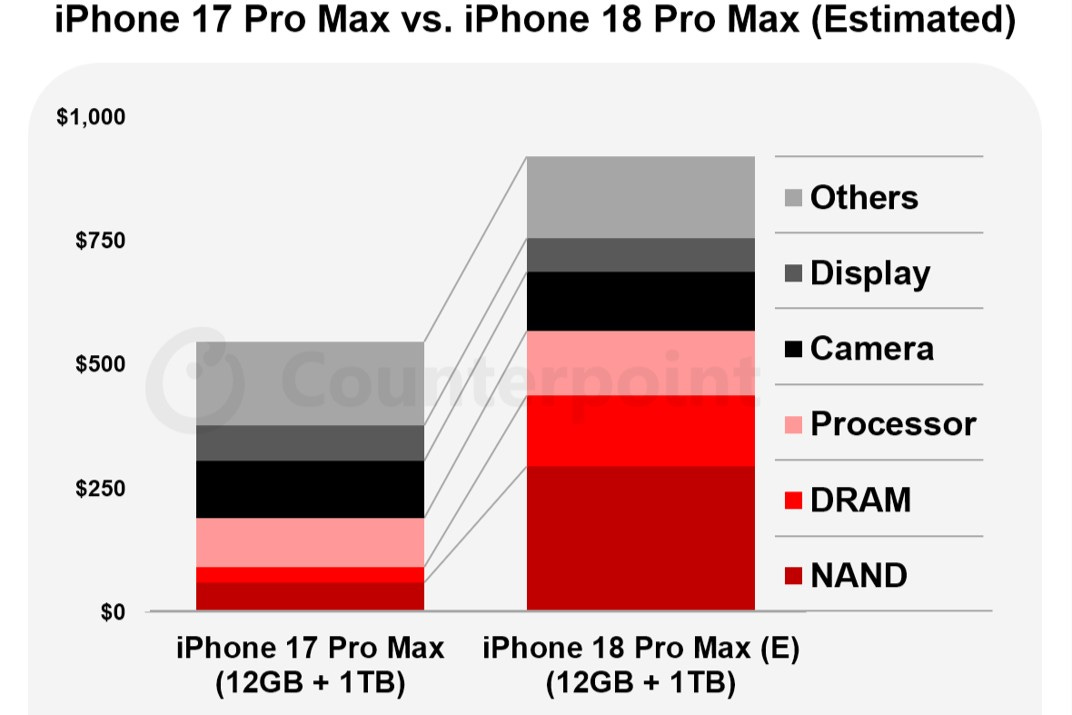
The analyst group shared an infographic showing the bill of materials (BOM) of the iPhone 18 Pro Max versus last year’s iPhone 17 Pro Max, which details the upcoming handset will cost Apple approximately $300 more to produce than the prior model. The BOM of the iPhone 18 Pro Max is about $800, while the production cost of the iPhone 17 Pro Max is about $500, for its highest tiered models with 1TB internal storage. Notably, the infographic does not give exact numbers; however, even estimates can paint a picture as to what is going on with the production and pricing of the upcoming smartphone.
PhoneArena estimates that the increased production costs could result in the iPhone 18 Pro Max starting around $1,399, while higher-tier 512GB and 1TB models could be priced at about $1,649 and $1,899, respectively.
While it is customary for hardware production costs to increase slightly year-over-year, such a large jump is unusual under typical circumstances. Currently, the tech industry has suffered under the high demand for memory chips, which has caused inflation across several brands, not only Apple. With companies paying to purchase the components going into their devices, they are just passing down that cost to consumers in the form of increased product prices.
The publication noted that the price of the memory and storage together cost Apple approximately $41 to build a 256GB model of the iPhone 17 Pro Max. Moving forward, the cost of a 12GB RAM module will likely be more expensive than the combined components, to give perspective on the infographic. Much older iPhone models had even lower BOM, such as the 256GB iPhone 16 Pro Max which cost $485 to produce, and the 256GB iPhone 15 Pro Max, which had a $453 BOM. This is before considering other aspects of product development, such as marketing, which also takes up a considerable chunk of Apple’s budget. The memory shortages are such an anomaly, when factored in could mean that Apple likely won’t make much if any profit on the iPhone 18 line, despite the price increases.
As said, Apple is not the only company challenged with the memory shortages in the tech industry. Google recently announced the August 12 launch event for its next generations Pixel devices. Rumors suggest that the brand may stop offering 128GB storage options as its minimum and shift the base models to a 256GB minimum. This change may also come with a price increase.